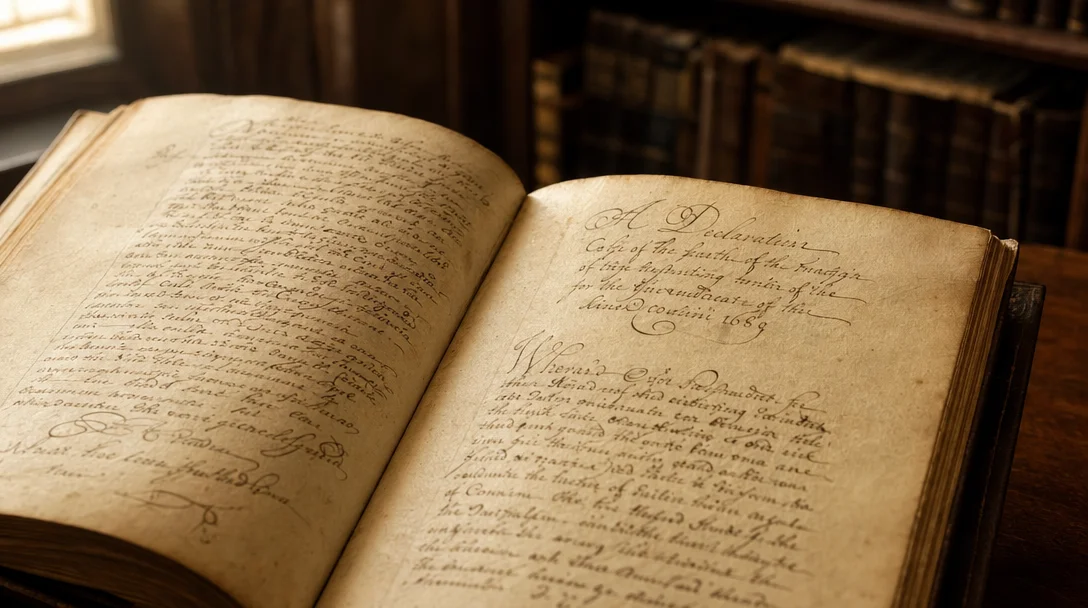
A Student's Dispatch from Holland: William Nicolson's 1678 Travel Manuscript Is Now Online

Queen's College MS 68 — Iter Hollandicum — is a 1678 manuscript travel account of Holland written by William Nicolson as a young Oxford student for his powerful patron Joseph Williamson. Recently added to Digital Bodleian, it offers a rare glimpse of one of England's future bishops before his career was made — observing the Dutch Golden Age at firsthand.

In the summer of 1678, a student at The Queen's College, Oxford set off for Holland. He was around twenty-two, and his name was William Nicolson. The trip was not entirely his own idea: he was traveling at the direction of Joseph Williamson (a senior diplomat who had served as Secretary of State under King Charles II, and a powerful patron with strong ties to Queen's College), who wanted a careful account of the Dutch towns Nicolson would pass through. When Nicolson returned, he wrote it all up in a manuscript he titled Iter Hollandicum — a Latin shorthand meaning "the Dutch journey." That manuscript, now held at The Queen's College Library as MS 68, was announced by the library as newly available on Digital Bodleian in April 2026. It is now freely viewable online for the first time.
The announcement drew relatively little attention when it was posted 1, and that absence of fanfare is, in a way, the point. Iter Hollandicum is not a famous text. It is not a work of literature or theology or natural philosophy. It is the careful travel notes of a young Oxford student who went to Holland when Holland was, by almost any measure, one of the most commercially and culturally active countries in Europe — and wrote down what he saw.

What Nicolson was looking at

The Netherlands in 1678 was near the peak of what historians call the Dutch Golden Age, though the political picture was complicated. The country had just come through the Franco-Dutch War, in which Louis XIV's army had driven deep into the Republic and temporarily occupied Utrecht and other major towns. The Treaty of Nijmegen, which ended the conflict, was signed that same year Nicolson arrived. Amsterdam was still the world's dominant trading port. Dutch commercial and financial infrastructure (the joint-stock company, the commodity exchange, marine insurance, the public bank) had been exported and imitated across Europe. The visual arts were at an extraordinary pitch; Vermeer had died just three years earlier, Rembrandt nine years before that.
An Englishman arriving in those cities in the summer of 1678 would have been stepping into a culture that England was simultaneously learning from, competing with, and sometimes at war against. Nicolson was there to observe, and he was there with a patron who expected a written report.

The patron and the purpose

Joseph Williamson was not simply a wealthy sponsor who liked supporting talented young men. He had served as Secretary of State for much of the 1670s and had built one of the most systematic correspondence networks in Restoration England, relying heavily on informants across Europe. His ties to Queen's College ran deep: he had studied there himself, and would eventually become one of the college's most significant benefactors.
A travel account prepared by a young Queen's taberdar (the term for scholarship students at Queen's College) for Williamson sits somewhere between a student exercise, an informal intelligence dispatch, and a letter of account. Nicolson was documenting the Dutch towns not as a tourist but as a correspondent. The manuscript's full title — "account of a journal to some of the principal towns of Holland" — suggests a systematic effort rather than a personal diary 2.

A taberdar's notebook

Nicolson went on to have a distinguished career far removed from student travel writing. He became a clergyman, a scholar of ecclesiastical history, and eventually Bishop of Derry and Archbishop of Cashel — positions of considerable authority in the Church of Ireland. He was also a Fellow of the Royal Society, known for his English Historical Library, a bibliographical guide to Anglo-Saxon and English history published in the early 1700s. None of that, however, is visible yet in Iter Hollandicum. The manuscript is a young man's document: the observations of someone who was still learning, writing to impress an older man of power and influence.
That compression of biography — the student who became the bishop, the taberdar's notebook that survives in an Oxford library three and a half centuries later — is one of the things that makes this kind of manuscript useful in ways that finished, published works are not. We see Nicolson before his later identity was fixed. We see what he chose to notice.

The manuscript at Queen's College

The physical object is a manuscript held in the library of The Queen's College, one of Oxford's oldest colleges, founded in 1341. The college's library has been part of the Bodleian Libraries system for centuries, and a portion of its manuscript holdings — including MS 68 — have now been digitized and made available through Digital Bodleian, Oxford's platform for rare books, manuscripts, and other digitized materials from across the Bodleian and its associated college libraries. MS 68 was among four manuscripts from Queen's College announced as newly added to Digital Bodleian in April 2026 1.
The digital version allows you to read Nicolson's handwriting at full resolution — the actual pages of the account he wrote up for Williamson, in his own hand, in the months after he came back from Holland in 1678.

Read it online

The full manuscript is available free on Digital Bodleian.
Loading link preview…
2

References

  1. 1Queen's College Library – four new manuscripts added to Digital Bodleian
  2. 2Queen's College MS 68 – Iter Hollandicum

Add more perspectives or context around this Drop.

  • Sign in to comment.